I resisted Math-U-See for years. Too expensive, I said. Too exclusive; why, it's only sold through distributers! I am sure it must be trendy and have no substance.
So, first I used Miquon because it was cheap, but still manipulative-based. Then I flip-flopped over to A Beka, because although the Miquon was non-traditional, I also found that it wasn't very effective or very well-organized. But I missed the hands-on and hated the busy work of A Beka. Then I looked at Saxon - eww! I must have done some other things in there too, including some Walmart-type workbooks.
Then my friend Barb gave a short presentation on MUS during our homeschool support meeting. I was enthralled. It made sense! It was hands-on! It was mastery-based! She had been using it for years with her four kids and still liked it! I was sold.
I went to place my order only to find that they were coming out with new books in the next few weeks, so I breathlessly waited for the new editions.
Oh when I finally got them, I was so excited, but also intimidated! I had to make something called Decimal Street. Man, I was a little overwhelmed by that, but I finally buckled down and got to it. It was AWESOME!!
The lessons all come on DVD. I use the DVD's to teach the kids. I sit with them and watch their new lessons and then they do the pages pretty much independently, unless they have a problems. Mr. Demme explains things very thoroughly and clearly, using the blocks to illustrate. I often learn to look at math in a new way myself! The nice thing about the DVD is, no matter how many times you replay it, Mr. Demme is always just as sweet and patient as he was the first time. Unlike Mom. LOL
I like the fact that there are 6 pages per lesson and you can do them all or just 1, depending on the mastery the child has of the information.
I love the blocks! A friend just told me she was trying to do MUS and it wasn't working out well. In the course of the conversation, she told me she hadn't bought the blocks! What? You're teaching MUS to a 1st grader without the blocks? I don't think I'd attempt that! I think I've convinced her to order them! LOL
This will be our second full year with Math-U-See and I don't foresee us ever needing to change curriculums!
Wednesday, September 14, 2005


Thursday, September 1, 2005
Mystery of History
Thanks to my good friend Maryann, I found the perfect History curriculum. In my humble opinion, of course. :-)
HERE IT IS!! The Mystery of History: Volume 1 by Linda Lacour Hobar.
As soon as I picked it up and started paging through it, I knew it was perfect for us.
Short lessons written in a conversational manner
Starts at Creation and has a Biblical point of view
Includes Biblical events mixed in with other historical events
Can be done with all age students
Not a traditional "textbook" or a workbook
Has cool hands-on activities for each lesson
Organized chronologically and includes history from all over the world, not just western civilization
Includes timeline work
Includes map work
Hobar has written Volume 2 and is working on Volume 3. There will be 5 volumes when it is all completed. When I get to the end of Volume 5, I plan to start over again with Volume 1.
I planned my lessons out by writing down the pages we plan to cover each day and by choosing the activities we plan to do. I noted the items needed for each activity, so I am not surprised on the day that we need a white sheet cake and colored frosting.
Several of the homeschooling moms I know have also decided to use Mystery of History. I am excited that other people will be doing it alongside of us, because that only can mean more support!
If you are still looking for a history curriculum you can really enjoy, give this one a try! (Will post more later in the year, after I've had a chance to try it.)
HERE IT IS!! The Mystery of History: Volume 1 by Linda Lacour Hobar.
As soon as I picked it up and started paging through it, I knew it was perfect for us.
Short lessons written in a conversational manner
Starts at Creation and has a Biblical point of view
Includes Biblical events mixed in with other historical events
Can be done with all age students
Not a traditional "textbook" or a workbook
Has cool hands-on activities for each lesson
Organized chronologically and includes history from all over the world, not just western civilization
Includes timeline work
Includes map work
Hobar has written Volume 2 and is working on Volume 3. There will be 5 volumes when it is all completed. When I get to the end of Volume 5, I plan to start over again with Volume 1.
I planned my lessons out by writing down the pages we plan to cover each day and by choosing the activities we plan to do. I noted the items needed for each activity, so I am not surprised on the day that we need a white sheet cake and colored frosting.
Several of the homeschooling moms I know have also decided to use Mystery of History. I am excited that other people will be doing it alongside of us, because that only can mean more support!
If you are still looking for a history curriculum you can really enjoy, give this one a try! (Will post more later in the year, after I've had a chance to try it.)
Alphabet Island Phonics
I used Alphabet Island Phonics to teach Emily to read and it worked very well. Now it is entirely possible that Emily would have learned to read easily with ANY program. I didn't discover this program until David had tried A Beka phonics, Teach Your Child to Read in 100 Easy Lessons, and probably some other things that have thankfully faded into the depths of my memory. David had a much harder time learning to read than Emily did, but I have a feeling that is just their different learning styles and not the curriculum. HOWEVER, I was very pleased with Alphabet Island Phonics and plan to use it with James and Suzy.
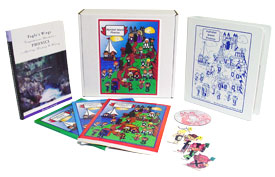
Eagles Wings Products - Alphabet Island Phonics
I am going to start using Alphabet Island Level 1 with James next week. He is 5-3/4. We will start with the kindergarten level curriculum, even though he is going into "first grade". There are 2 sections in the first level.
Each lesson is supposed to take 15 minutes, but in my experience with Emily, they took longer. Songs, games, stories, and more are all included to make the phonics rules memorable. There are workbook pages too to reinforce the concepts, and since we are doing phonics and it is important to see the letters and to write them, I will likely have him do all of the workbook.
Depending on how quickly he picks it up, we may supplement with Phonics Pathways and the Pyramid book that goes along with it. If he needs more practice, I will add those in.
Looking forward to introducing James to the world of reading!
Eagles Wings Products - Alphabet Island Phonics
I am going to start using Alphabet Island Level 1 with James next week. He is 5-3/4. We will start with the kindergarten level curriculum, even though he is going into "first grade". There are 2 sections in the first level.
Each lesson is supposed to take 15 minutes, but in my experience with Emily, they took longer. Songs, games, stories, and more are all included to make the phonics rules memorable. There are workbook pages too to reinforce the concepts, and since we are doing phonics and it is important to see the letters and to write them, I will likely have him do all of the workbook.
Depending on how quickly he picks it up, we may supplement with Phonics Pathways and the Pyramid book that goes along with it. If he needs more practice, I will add those in.
Looking forward to introducing James to the world of reading!
Monday, August 29, 2005
Art Curriculum
I posted a few weeks ago about my art curriculum, or really about the importance of it. But since I planned out art for the year today, I thought I would at least mention it again and give a few details.
I use 2 main books to teach art.

How to Teach Art to Children - Evan-Moor Publishers (for grades 1-6)
and
Meet the Masterpieces: Strategies, Activities, and Posters to Explore Great Works of Art - Scholastic (for grades 2-5)
(I cannot find an online pic I can show you, but here is the amazon page - Amazon.com book page (It's apparently out of print now, but well worth finding if you can.)
Last year, we studied Line, Shape, and Color from the Evan-Moor book and Pieter Bruegel, Diego Velasquez, and Hokusai from the Scholastic book.
This year we will study Value, Texture, Form, and Space, as well as study the following artists: Winslow Homer, Pierre Auguste Renoir, Mary Cassatt, Pablo Picasso, and Romare Bearden.
I planned 83 art lessons. We do art nearly every day, but since we are adding history this year, I think there will be days when we do art in history or science and won't do it separately too. I schedule Art right after Bible, so it is our second subject of the day. I find that it helps the kids get "into" school and gets their creativity flowing, which in turn helps them academically. Also I can get the "together" work out of the way first and then they can do their independent work later, rather than me trying to gather everyone back at a later time, when someone might be in the middle of an important assignment.
The Evan-Moor book has two parts. Part 1 is the main section of the book. It includes the art lessons that are about Value, Texture, Form, and Space all are introducing an art concept to the children. Each lesson has either an art project or a small group experience to reinforce the concept. The art projects in this book are particularly eye-catching and attractive, in my opinion.
Part 2 is all art projects based on a famous artist, such as Edward Degas, or a famous art technique, such as Anasazi pottery. I have sprinkled these 24 lessons throughout the year, so we get a break from the normal routine. I also found examples of each of these famous works or techniques online and saved them to my hard drive, so I can show the children some examples when it's time for that lesson. No more jumping online while they wait, colored pencils in hand.
After every section from the Evan-Moor book, I have scheduled a section from Meet the Masterpieces. This book has a short section on the artist's life, which will be our Day 1 of that section. We will add the artist to our main timeline and find out more about him/her if we so desire. On Day 2, we take a close look at one of the artist's works. The book gives some excellent questions to ask the students about the work, and even gives you the answers, which is great for those of us who did not study much great art. (Apparently this book originally came with posters of these works, but I do not have those. Therefore, I searched the internet for copies of the works and printed them out. I put them in my lesson plan binder, along with my lesson sheets for art and I'm all set!)
For Days 3-5 of these lessons, the book has differing activities that build on the concepts learned about the artist and/or the time period. Some of these I like, and some I don't, but I have chosen the ones I want to do and listed them on my plan sheet.
Something else I did to make all this easier was to list out all the supplies needed for each lesson, so I can quickly look ahead and make sure I have the 12x18 white paper that is needed, or stop at the store for dried beans.
I think Suzy and James will be doing art with us most days this year and I am looking forward to something else that we can all do together!
If you do not schedule art regularly, I encourage you to do it. It has made a big difference in our homeschooling!
I use 2 main books to teach art.
How to Teach Art to Children - Evan-Moor Publishers (for grades 1-6)
andMeet the Masterpieces: Strategies, Activities, and Posters to Explore Great Works of Art - Scholastic (for grades 2-5)
(I cannot find an online pic I can show you, but here is the amazon page - Amazon.com book page (It's apparently out of print now, but well worth finding if you can.)
Last year, we studied Line, Shape, and Color from the Evan-Moor book and Pieter Bruegel, Diego Velasquez, and Hokusai from the Scholastic book.
This year we will study Value, Texture, Form, and Space, as well as study the following artists: Winslow Homer, Pierre Auguste Renoir, Mary Cassatt, Pablo Picasso, and Romare Bearden.
I planned 83 art lessons. We do art nearly every day, but since we are adding history this year, I think there will be days when we do art in history or science and won't do it separately too. I schedule Art right after Bible, so it is our second subject of the day. I find that it helps the kids get "into" school and gets their creativity flowing, which in turn helps them academically. Also I can get the "together" work out of the way first and then they can do their independent work later, rather than me trying to gather everyone back at a later time, when someone might be in the middle of an important assignment.
The Evan-Moor book has two parts. Part 1 is the main section of the book. It includes the art lessons that are about Value, Texture, Form, and Space all are introducing an art concept to the children. Each lesson has either an art project or a small group experience to reinforce the concept. The art projects in this book are particularly eye-catching and attractive, in my opinion.
Part 2 is all art projects based on a famous artist, such as Edward Degas, or a famous art technique, such as Anasazi pottery. I have sprinkled these 24 lessons throughout the year, so we get a break from the normal routine. I also found examples of each of these famous works or techniques online and saved them to my hard drive, so I can show the children some examples when it's time for that lesson. No more jumping online while they wait, colored pencils in hand.
After every section from the Evan-Moor book, I have scheduled a section from Meet the Masterpieces. This book has a short section on the artist's life, which will be our Day 1 of that section. We will add the artist to our main timeline and find out more about him/her if we so desire. On Day 2, we take a close look at one of the artist's works. The book gives some excellent questions to ask the students about the work, and even gives you the answers, which is great for those of us who did not study much great art. (Apparently this book originally came with posters of these works, but I do not have those. Therefore, I searched the internet for copies of the works and printed them out. I put them in my lesson plan binder, along with my lesson sheets for art and I'm all set!)
For Days 3-5 of these lessons, the book has differing activities that build on the concepts learned about the artist and/or the time period. Some of these I like, and some I don't, but I have chosen the ones I want to do and listed them on my plan sheet.
Something else I did to make all this easier was to list out all the supplies needed for each lesson, so I can quickly look ahead and make sure I have the 12x18 white paper that is needed, or stop at the store for dried beans.
I think Suzy and James will be doing art with us most days this year and I am looking forward to something else that we can all do together!
If you do not schedule art regularly, I encourage you to do it. It has made a big difference in our homeschooling!
Saturday, August 27, 2005
Homeschool Camping
One of the leadership team members of my homeschool group had a great idea this summer - how about a week of homeschool camping?! FUN, I thought! So she planned out the week and we just returned from it yesterday. It was a LOVELY time.
Here are some of the details.
We chose the dates to coincide with the start of school here, so the campground would be emptier. We chose to camp Monday-Friday, so as to avoid weekend campground congestion. We chose a state park in our county, so it would be close enough to most people's homes that they could go home if they needed to - for sports practice, feeding animals, etc...
State parks in Michigan allow site-specific reservations, so we chose a section of the campground and each family made its own reservations in whatever site they wanted to have. We ended up with 4 families spending all 4 nights and 8-9 more families spending 2 or 3 nights.
We planned activities each day, such as face painting, rock painting, night hike, fishing, swimming, etc... We invited families from our group to come out and join us for the daytime activities if they couldn't camp with us. We had several more families join us for those activities. We tried very hard to have something each day, but not so many activities that we felt overscheduled.
We shared some meals - sometimes intentionally, and sometimes it just happened. We gathered around one or two main fire pits. The kids had a lot of freedom to run around because there were only a few other campers on our end of the campground.
I think everyone enjoyed it a lot and we plan to schedule another camping week next year!
Here are some of the details.
We chose the dates to coincide with the start of school here, so the campground would be emptier. We chose to camp Monday-Friday, so as to avoid weekend campground congestion. We chose a state park in our county, so it would be close enough to most people's homes that they could go home if they needed to - for sports practice, feeding animals, etc...
State parks in Michigan allow site-specific reservations, so we chose a section of the campground and each family made its own reservations in whatever site they wanted to have. We ended up with 4 families spending all 4 nights and 8-9 more families spending 2 or 3 nights.
We planned activities each day, such as face painting, rock painting, night hike, fishing, swimming, etc... We invited families from our group to come out and join us for the daytime activities if they couldn't camp with us. We had several more families join us for those activities. We tried very hard to have something each day, but not so many activities that we felt overscheduled.
We shared some meals - sometimes intentionally, and sometimes it just happened. We gathered around one or two main fire pits. The kids had a lot of freedom to run around because there were only a few other campers on our end of the campground.
I think everyone enjoyed it a lot and we plan to schedule another camping week next year!
Thursday, August 11, 2005
Bible Curriculum
I am going to do a series of posts on the different curricula, resources, and books I will be using this year for each subject.
Today I will address the subject of Bible because it is the most important and also because it is one of the few curriculum resources that I didn't have a single question regarding if I planned to continue using it or not. I have the first 105 lessons of Bible planned out already.
I have been using the Bible Study Guide for All Ages by Donald and Mary Baker for several years now. We are finishing up Volume 2. There are 4 volumes. We will finish the last lessons of Volume 2 and get started on Volume 3 before Christmas.
While at the website, I noticed that the company has REDONE the activity pages and they are WONDERFUL!! Such an improvement! And just as I was really getting all geeked about it, I realized that the pages are only redone for Volume 1, which we won't get back to for quite some time! Hopefully, they will have these redone in time for us to be able to use some for Volume 3. I may still order the "classic" pages for the rest of volume 2 and see how it goes.
This past year, I just printed out coloring pages to go with each lesson from Calvary Chapel Children's Ministry Curriculum. The coloring sheets are very high quality, are free, and come in .pdf format, which means they print out perfectly. The kids color while I read the Bible passages for the day. I could certainly do that again, and I may.
I like the BSG because during the 4 year cycle, the students cover the ENTIRE Bible, not just Creation, Noah's Ark, The Loaves and the Fishes, etc... Map work, timeline work, memory work, and life application are also included. It really is a curriculum for ALL ages because you can do as much or as little as you like, or do more with the older kids while the younger ones do their activity page. (We take longer than a year to do a volume, both because we don't always do Bible every day, and also because of the things I add to my Bible curriculum.)
Between units of BSG, I am interspersing units from Character Building for Families by Lee Ann Rubsam. The 4 topics we will cover during those first 100 lessons are: Loyalty, Deference, Cheerfulness, Gentleness (Kindness). We will continue later in the year with Contentment, Gratitude, Truthfulness, Servanthood, and Hospitality. We may not get all those topics finished before next school year, however.
We used CBF this past year and I was impressed with how thorough and user-friendly the curriculum is. It is nothing fancy to look at - simply a black and white teacher manual that is comb-bound. But the content is excellent.
As I blogged about earlier, we will also be learning a hymn a month, and we will also do a long scripture passage each month. I am still choosing the Scripture passages, but the hymns are all chosen.
If the kids have any Scripture memory from the Pioneer Club they attend on Wednesday nights, we will add that in as well. This past year they didn't have much memory work, at least not compared to the AWANA program they attended for 2 years before that.
Today I will address the subject of Bible because it is the most important and also because it is one of the few curriculum resources that I didn't have a single question regarding if I planned to continue using it or not. I have the first 105 lessons of Bible planned out already.
I have been using the Bible Study Guide for All Ages by Donald and Mary Baker for several years now. We are finishing up Volume 2. There are 4 volumes. We will finish the last lessons of Volume 2 and get started on Volume 3 before Christmas.

While at the website, I noticed that the company has REDONE the activity pages and they are WONDERFUL!! Such an improvement! And just as I was really getting all geeked about it, I realized that the pages are only redone for Volume 1, which we won't get back to for quite some time! Hopefully, they will have these redone in time for us to be able to use some for Volume 3. I may still order the "classic" pages for the rest of volume 2 and see how it goes.
This past year, I just printed out coloring pages to go with each lesson from Calvary Chapel Children's Ministry Curriculum. The coloring sheets are very high quality, are free, and come in .pdf format, which means they print out perfectly. The kids color while I read the Bible passages for the day. I could certainly do that again, and I may.
I like the BSG because during the 4 year cycle, the students cover the ENTIRE Bible, not just Creation, Noah's Ark, The Loaves and the Fishes, etc... Map work, timeline work, memory work, and life application are also included. It really is a curriculum for ALL ages because you can do as much or as little as you like, or do more with the older kids while the younger ones do their activity page. (We take longer than a year to do a volume, both because we don't always do Bible every day, and also because of the things I add to my Bible curriculum.)
Between units of BSG, I am interspersing units from Character Building for Families by Lee Ann Rubsam. The 4 topics we will cover during those first 100 lessons are: Loyalty, Deference, Cheerfulness, Gentleness (Kindness). We will continue later in the year with Contentment, Gratitude, Truthfulness, Servanthood, and Hospitality. We may not get all those topics finished before next school year, however.
We used CBF this past year and I was impressed with how thorough and user-friendly the curriculum is. It is nothing fancy to look at - simply a black and white teacher manual that is comb-bound. But the content is excellent.
As I blogged about earlier, we will also be learning a hymn a month, and we will also do a long scripture passage each month. I am still choosing the Scripture passages, but the hymns are all chosen.
If the kids have any Scripture memory from the Pioneer Club they attend on Wednesday nights, we will add that in as well. This past year they didn't have much memory work, at least not compared to the AWANA program they attended for 2 years before that.
Wednesday, August 10, 2005
Co-op
I thought it would be fun to post the classes my children will be taking at our homeschool co-op this fall. (I am the co-op coordinator.)
David - age 10-1/2
Computer Hardware Isn't So Hard
Physical Education
Karate
Chess Club
Drawing
David - age 10-1/2
Computer Hardware Isn't So Hard
Physical Education
Karate
Chess Club
Drawing
Emily - age 8-1/2
Kids' Concoctions
Physical Education
Cardmaking
Art Concepts
Choir
James - age 5-1/2
Pet Friends
Little Signers (American Sign Language)
Karate
Show & Tell Storytime OR Open Gym
AEIOU100
Suzy - age 3
Active Adventures
Baby Ballet - 25 min
Open Gym - 25 min
Playroom
Fun with Playdough
Playroom
We are very much looking forward to co-op! We meet 8 times in the fall and 8 times in the spring. Some of the classes will change in the spring.
Wednesday, August 3, 2005
Support Meeting Last Night
As the coordinator of a homeschool group, I strive to provide a welcoming and interesting forum for all kinds of moms at our support group meetings. Last night was our first group meeting since May.
Our topic was "Starting the Homeschool Year" and we asked people to bring something new (to them) that they were EXCITED about using during the upcoming year. We had about twenty women attend the meeting! Lots of people shared things they were excited about. Here is the list posted on our group website.
Meeting Resource List
I have been in leadership in this group for about 7 years and was one of the founding members. Our monthly attendance has been averaging 6-12 women most of that time. Now and then we would have a large meeting, but the average meeting was under 10 moms. Last May we had 19 moms, so maybe this is a hint that our meetings are going to be larger this year. Makes sense because we have a co-op now that has 59 families enrolled.
I do enjoy facilitating the group discussions. My training as a La Leche League Leader comes in handy in this role. Sometimes we have an informal discussion, as we did last night, and sometimes we invite a speaker to come in. Sometimes I prepare something to share. We will have speakers at our next 3 meetings and then we will have a Christmas social.
Do you attend a homeschool support group? If you do, what do you like most about it? If you don't, why not?
Our topic was "Starting the Homeschool Year" and we asked people to bring something new (to them) that they were EXCITED about using during the upcoming year. We had about twenty women attend the meeting! Lots of people shared things they were excited about. Here is the list posted on our group website.
Meeting Resource List
I have been in leadership in this group for about 7 years and was one of the founding members. Our monthly attendance has been averaging 6-12 women most of that time. Now and then we would have a large meeting, but the average meeting was under 10 moms. Last May we had 19 moms, so maybe this is a hint that our meetings are going to be larger this year. Makes sense because we have a co-op now that has 59 families enrolled.
I do enjoy facilitating the group discussions. My training as a La Leche League Leader comes in handy in this role. Sometimes we have an informal discussion, as we did last night, and sometimes we invite a speaker to come in. Sometimes I prepare something to share. We will have speakers at our next 3 meetings and then we will have a Christmas social.
Do you attend a homeschool support group? If you do, what do you like most about it? If you don't, why not?
Friday, July 29, 2005
I was conversing with my friend Jen the other day (:::waves at Jen:::) and we got to talking about art. She said she feels people are either born with artistic talent or they aren't.
While I do agree with that to some extent, I also feel that everyone can attain a certain level of competency in art. I think the main problem is not a general lack of talent, but a deficiency in the education process.
Most of us started school loving to create things, to draw, to express ourselves with color. Somewhere along the line, we realized we "weren't good at it". We may have even had teachers or other adults denigrate our abilities and make us afraid to try. But what this really boils down to is that most of us were not given the basic tools that we needed to succeed at art.
A person who is intrinsically good at art may discover some principles of art on his own, or he may have people around who notice his special aptitude for art and who then provides him with specialized instruction that nurtures his gift.
In contrast, the student with an average art ability probably doesn't discover many art techniques on his own. The art classes provided in most schools don't have a K-12 scope and sequence. In my experience, most art teachers love art and do what they like or what they find interesting. Most school districts do not have a cohesive plan for allowing each student to reach a basic level of competency in art. The basic attitude seems to be "Let the students explore all kinds of art and learn to appreciate art and that's good enough."
An analogy may help me explain this better. We all know that there are some students who are mathematically inclined. I have a friend who is studying higher mathematics at the graduate school level and I am completely lost whenever she describes the things she is studying. She is obviously gifted mathematically and I would never dream of achieving the mathematical understanding that she has mastered.
However, does that mean that because I am not "mathematically inclined" that I should not expect to achieve a basic level of competency in math? No. We expect that all students will become competent enough to balance a checkbook, understand taxes, and other common life skills that involve math. When people achieve these skills, do we say that they are "so mathematical!"? No, we expect that. It is a basic level of competency and when someone doesn't achieve it, we are often shocked.
Art should be thought of the same way. The unplanned method of teaching art ISN'T good enough. We must provide incremental art instruction for students so they can achieve basic skills in art. Everyone can learn to draw, as well as master other basic art skills.
Case in point. I have NEVER been artistic. I cannot draw. Really. I have never been considered creative artistically. However, in the spring of 2003, after reading about nature study and nature journalling, I was inspired to learn a little about watercolors. So, I did some reading about it and tried it out.
Here are my attempts at watercolor painting. (May 2003)
(Images have been removed)
Now, when my friend saw these, she said something about how "artistic" I am! LOL I am certainly NOT artistic. My point in showing you these is that if *I* can learn to do this, then ANYONE can. I don't expect to be Monet, but I would like to be able to draw or paint something recognizable.
How do I work this instruction out in my homeschool? Last year, I watched a video by Barry Stebbing that stressed the importance of art instruction. It only solidified my resolve. We do art nearly every school day. I find it important enough to do right after Bible most days. Getting the creative juices flowing really helps my children to concentrate on their academic work afterward. It does take a little longer, but I find that the payoff is worth it.
I have been using Evan-Moor's How to Teach Art to Children, which offers instruction on the seven elements of art: line, shape, color, value, texture, form, and space. The book is easy to use and includes lots of fun art projects and instruction. It's a great way to begin planned art instruction. After this, we will probably do some basic drawing lessons. Mom will be learning right along with her children!
While I do agree with that to some extent, I also feel that everyone can attain a certain level of competency in art. I think the main problem is not a general lack of talent, but a deficiency in the education process.
Most of us started school loving to create things, to draw, to express ourselves with color. Somewhere along the line, we realized we "weren't good at it". We may have even had teachers or other adults denigrate our abilities and make us afraid to try. But what this really boils down to is that most of us were not given the basic tools that we needed to succeed at art.
A person who is intrinsically good at art may discover some principles of art on his own, or he may have people around who notice his special aptitude for art and who then provides him with specialized instruction that nurtures his gift.
In contrast, the student with an average art ability probably doesn't discover many art techniques on his own. The art classes provided in most schools don't have a K-12 scope and sequence. In my experience, most art teachers love art and do what they like or what they find interesting. Most school districts do not have a cohesive plan for allowing each student to reach a basic level of competency in art. The basic attitude seems to be "Let the students explore all kinds of art and learn to appreciate art and that's good enough."
An analogy may help me explain this better. We all know that there are some students who are mathematically inclined. I have a friend who is studying higher mathematics at the graduate school level and I am completely lost whenever she describes the things she is studying. She is obviously gifted mathematically and I would never dream of achieving the mathematical understanding that she has mastered.
However, does that mean that because I am not "mathematically inclined" that I should not expect to achieve a basic level of competency in math? No. We expect that all students will become competent enough to balance a checkbook, understand taxes, and other common life skills that involve math. When people achieve these skills, do we say that they are "so mathematical!"? No, we expect that. It is a basic level of competency and when someone doesn't achieve it, we are often shocked.
Art should be thought of the same way. The unplanned method of teaching art ISN'T good enough. We must provide incremental art instruction for students so they can achieve basic skills in art. Everyone can learn to draw, as well as master other basic art skills.
Case in point. I have NEVER been artistic. I cannot draw. Really. I have never been considered creative artistically. However, in the spring of 2003, after reading about nature study and nature journalling, I was inspired to learn a little about watercolors. So, I did some reading about it and tried it out.
Here are my attempts at watercolor painting. (May 2003)
(Images have been removed)
Now, when my friend saw these, she said something about how "artistic" I am! LOL I am certainly NOT artistic. My point in showing you these is that if *I* can learn to do this, then ANYONE can. I don't expect to be Monet, but I would like to be able to draw or paint something recognizable.
How do I work this instruction out in my homeschool? Last year, I watched a video by Barry Stebbing that stressed the importance of art instruction. It only solidified my resolve. We do art nearly every school day. I find it important enough to do right after Bible most days. Getting the creative juices flowing really helps my children to concentrate on their academic work afterward. It does take a little longer, but I find that the payoff is worth it.
I have been using Evan-Moor's How to Teach Art to Children, which offers instruction on the seven elements of art: line, shape, color, value, texture, form, and space. The book is easy to use and includes lots of fun art projects and instruction. It's a great way to begin planned art instruction. After this, we will probably do some basic drawing lessons. Mom will be learning right along with her children!
Tuesday, July 26, 2005
Classical Kids
Long ago I was a schoolteacher. A multigrade classroom in a Christian school was my work environment for five years. I worked at a teacher supply store for a couple years during that time and spent just about all of my salary on teacher supplies.
One thing I bought back then was Classical Kids audio cassettes. Hopefully you've heard of these, but if you haven't, I do highly recommend them. Fascinating stories featuring music by famous composers familiarize the listeners with either lives of the composers or, as in the case of Mozart's Magic Flute, the plot of the opera.
The four cassettes I have are:
Mr. Bach Comes to Call: The great composer tells his story to a little girl
Mozart's Magic Fantasy: A journey through The Magic Flute
Vivaldi's Ring of Mystery: A tale of Venice and violins
Beethoven Lives Upstairs: A tale of genius and childhood

I dug these out and introduced them to my children last week, and these cassettes have been the only thing we have listened to in the car since! They particularly like the Vivaldi and Mozart selections. The stories are professionally recorded and the acting is beautifully done. Excerpts from the composer's most famous works are included, sometimes as background to the story and sometimes as short snippets just for listening pleasure, but always integrated with the plot.
There are several more Classical Kids selections that I do not yet own, but they are on my wish list! These are the titles I am hoping to get eventually:
Classical Kids Christmas: A telling of the Christmas story children's choirs singing your favorite carols
Hallelujah Handel!: Angels in the opera house
Mozart's Magnificent Voyage: A symphony of stories for all ages
Song of the Unicorn: A Classical Kids story with medieval music
Tchaikovsky Discovers America: A tale of courage and adventure
Daydreams and Lullabies: a celebration of poetry, song and classical music.
One note of caution. If yours is a family that avoids any mention of magic or spookiness, you will probably want to skip Mozart's Magic Fantasy and Vivaldi's Ring of Mystery. There is a lot of magic in the Mozart story and some slight spookiness in the Vivaldi story. I don't think it would offend most people, but amongst Christian homeschoolers, I do believe there are some who would find it unacceptable. I didn't use those two in my Christian school classroom because I felt that some parents could possibly have objections. However, I think that many families will find these stories both enchanting and enriching. You likely would have no objection to the stories about Bach and Beethoven. We personally have learned a lot and had our hearts touched by all of these stories.
As Beethoven believed (and we learned in the Beethoven Lives Upstairs story), "Music can change the world."
One thing I bought back then was Classical Kids audio cassettes. Hopefully you've heard of these, but if you haven't, I do highly recommend them. Fascinating stories featuring music by famous composers familiarize the listeners with either lives of the composers or, as in the case of Mozart's Magic Flute, the plot of the opera.
The four cassettes I have are:
Mr. Bach Comes to Call: The great composer tells his story to a little girl
Mozart's Magic Fantasy: A journey through The Magic Flute
Vivaldi's Ring of Mystery: A tale of Venice and violins
Beethoven Lives Upstairs: A tale of genius and childhood
I dug these out and introduced them to my children last week, and these cassettes have been the only thing we have listened to in the car since! They particularly like the Vivaldi and Mozart selections. The stories are professionally recorded and the acting is beautifully done. Excerpts from the composer's most famous works are included, sometimes as background to the story and sometimes as short snippets just for listening pleasure, but always integrated with the plot.
There are several more Classical Kids selections that I do not yet own, but they are on my wish list! These are the titles I am hoping to get eventually:
Classical Kids Christmas: A telling of the Christmas story children's choirs singing your favorite carols
Hallelujah Handel!: Angels in the opera house
Mozart's Magnificent Voyage: A symphony of stories for all ages
Song of the Unicorn: A Classical Kids story with medieval music
Tchaikovsky Discovers America: A tale of courage and adventure
Daydreams and Lullabies: a celebration of poetry, song and classical music.
One note of caution. If yours is a family that avoids any mention of magic or spookiness, you will probably want to skip Mozart's Magic Fantasy and Vivaldi's Ring of Mystery. There is a lot of magic in the Mozart story and some slight spookiness in the Vivaldi story. I don't think it would offend most people, but amongst Christian homeschoolers, I do believe there are some who would find it unacceptable. I didn't use those two in my Christian school classroom because I felt that some parents could possibly have objections. However, I think that many families will find these stories both enchanting and enriching. You likely would have no objection to the stories about Bach and Beethoven. We personally have learned a lot and had our hearts touched by all of these stories.
As Beethoven believed (and we learned in the Beethoven Lives Upstairs story), "Music can change the world."
Subscribe to:
Posts (Atom)